Dotting the i’s and crossing the t’s: that’s what Opiliones 3D will do together with Demcon Metal Injection Molding, among others, in the coming months and then launch cost-effective 3D metal printing on an industrial scale by the summer of 2026. A follow-up to the 3DOP project, in which Peter Sluiter and his team laid the foundation.
“We need another six months to make the machine more process secure and to explore the limits of which geometries we can sinter. Then we will have a cost-effective 3D metal printer with repeatable quality,” says Peter Sluiter, co-founder and director of 3D printer manufacturer Opiliones 3D.
Opiliones want to take the step towards circular 3D metalprinten
Using waste as source for feedstock
The EFRO project, in which the results of the 3DoP project are being refined, will also have a broader scope, because Demcon Bond3D is also participating, as are software developer Senovi Nederland and Unique Metal 3D Printing, which 3D prints dental frame prostheses. Peter Sluiter wants to take the step towards circular metal printing: the powder that is unsuitable for Unique Metal 3D Printing and now ends up as waste will be processed into granulate with which Opiliones will be able to 3D print. Polymer Science Park in Zwolle is responsible for the validation of the material.
Shorten time to market
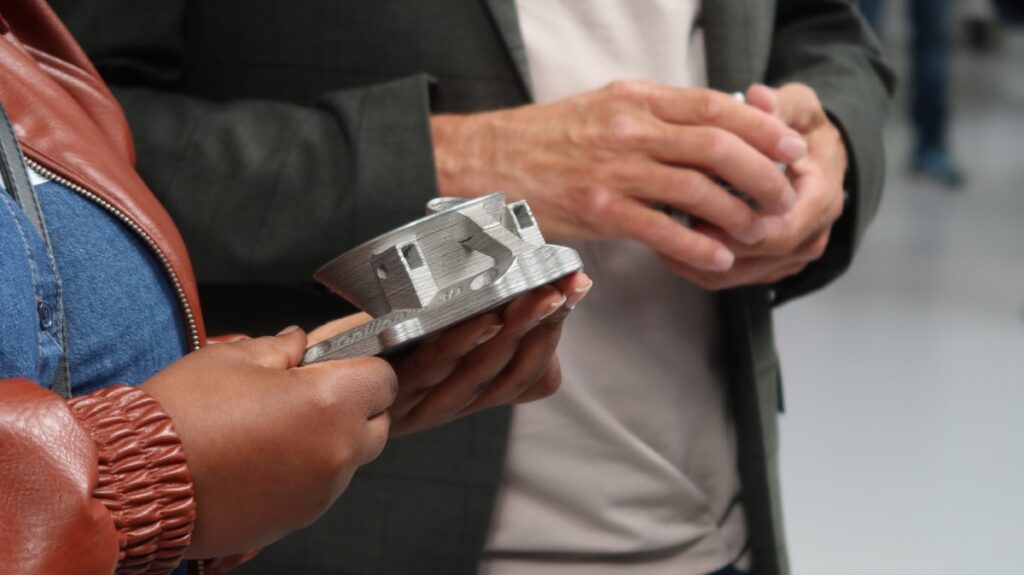
Additive manufacturing can help the industry bring products to market faster and cheaper. For many Western European manufacturers, this is crucial; Time-to-market is a critical success factor. The problem, however, is that Laser Powderbed Fusion, the most widely used metal printing technology, requires high investments in equipment and knowledge. Opiliones has therefore developed an alternative technology in the 3DoP project. Printing is done with MIM granules (Metal Injection Molding), pellets that contain 80% metal powder that is held together by a plastic binder. This material is cheap and available in many alloys. After 3D printing, the polymer is washed out and the final step is sintering. The metal is then compacted to 99.8%. In the 3DoP project, Opiliones has developed the printer to a certain level, found a solution for supporting fragile components during sintering and has done the first sintering tests.
Why is a follow-up project needed? Can’t your 3D printer just be put on the market?
Peter Sluiter: “We want to improve our 3D printer on seven more points to make the machine more stable and the process more secure. Because of the speed in the 3DoP project, we have made certain parts of plastic. Now we want to replace them with metal parts. Under pressure, plastic always creeps and eventually creates play, which makes the machine inaccurate. In the 3DoP project, we brought the printer to workshop level. The iterations of these technical parts bring the 3D printer to an industrial level, with repeatable quality. Without the 3DoP project, we would never have come as far as we are now.”
Exploring the sintering process
In addition, Opiliones will carry out tests together with Demcon to discover the limits of the geometries suitable for sintering. In fact, these are application tests for which the budget in the 3DoP project did not cover the full scope. Sintering is a costly process, mainly due to the use of shielding gases. Because Demcon participates in the new EFRO project, Opiliones can use Demcon’s sintering furnaces that are operational 24/7. Peter Sluiter: “Our promise to the market is that you can print any geometry that an Ultimaker can print in plastic with our machine as a greenfinch and subsequently sinter. To deliver on this promise, we still need to take a few steps.” After the new project, Demcon MIM will become the launching customer for the cost-effective 3D metal printing technology, just like Royal Eikelkamp. The MIM company will use the technique for cost-effective production of prototypes, pilot series and small production numbers, as a first step towards MIM parts. Customers then receive their metal components without having to invest substantially in a mould first. “Their customer can then deliver prototypes, the first series products, without an investment threshold for production. Only when the design is fixed and larger series are needed, do they have to invest in expensive moulds,” says Peter Sluiter.

Online portal: assistant 4.0?
The scope of the EFRO project has become broader. An online portal is also being developed with which print service companies – that will use the Opiliones (metal) printing technology – can automate the calculation. Demcon Bond3D wants to use this portal, which is secured by a Senovi Software module, in the Netherlands. The algorithms running in the background of the portal generate the G-code for the 3D printer from the scan data (STL file), which is linked to the production time and material consumption. Customers will soon only have to upload their 3D models and will immediately receive a price indication and delivery time. The portal already existed, but is now being further developed and mainly embedded in a highly secure environment, so that customer data is well secured. Peter Sluiter believes that such a portal is important for many more industrial companies than just 3D printing companies. “If we want to maintain value in relation to foreign parties, it is important that we can handle the entire customer journey as much as possible without the intervention of others,” he explains. China threatens to take a lead over Western companies in this area by building very smart chatbots with AI, which are to the point and act as an assistant 4.0.
Circular 3D printing
The third aspect of this new project is circularity. Unique 3D Metal Printing screens the metal powders before they enter the LPBF machine, because metal powders that are too small and too large are unsuitable for the quality requirements that apply to the frame prostheses. This powder is a waste stream in the company, which Opiliones wants to use to make MIM powder supplemented with polymer. Peter Sluiter: “These powders are extremely suitable for our cost-effective metal printing technology. Together with the Polymer Science Park and Senovi, we are going to investigate whether we can turn this residual flow into a granulate for our printing technology, so that we can make the metal printing branch of Opiliones circular.” This does not affect the quality of the 3D printed parts, as these are metal powders that are already removed from their material via sieves before they enter the machine at Unique 3D Metal Printing.
Innovation flows to keep European industry afloat A unique part of the 3DoP project has been the Open Call. SMEs in the EU have gained access to the knowledge of the 3DoP partners through this Open Call. For Opiliones 3D, this has resulted in an interesting contact that, if Peter Sluiter gets support for a project, will certainly be continued. A Slovenian army officer has developed a tourniquet based on the mechanism used by e.i. the inside of a helmet is simply made larger and smaller. Peter Sluiter: “The idea is to integrate this tourniquet into military combat uniforms. Anyone who gets arterial bleeding from the arm or leg on the battlefield can then close the vein by turning a knob with the tourniquet to prevent blood loss. The ten minutes that someone stays conscious longer increases the chances of survival considerably, especially if we combine this with a RFID tag so that the command center is automatically alerted and the location is transmitted.” Tecos, the Slovenian 3DoP partner, has further developed a first concept. Opiliones believes that with the FDM printing technology, it can create a proof of concept that will allow the inventor to produce a first series for further testing, together with uniform manufacturers. “We have to ensure that such innovation continues so that we keep European industry afloat.”