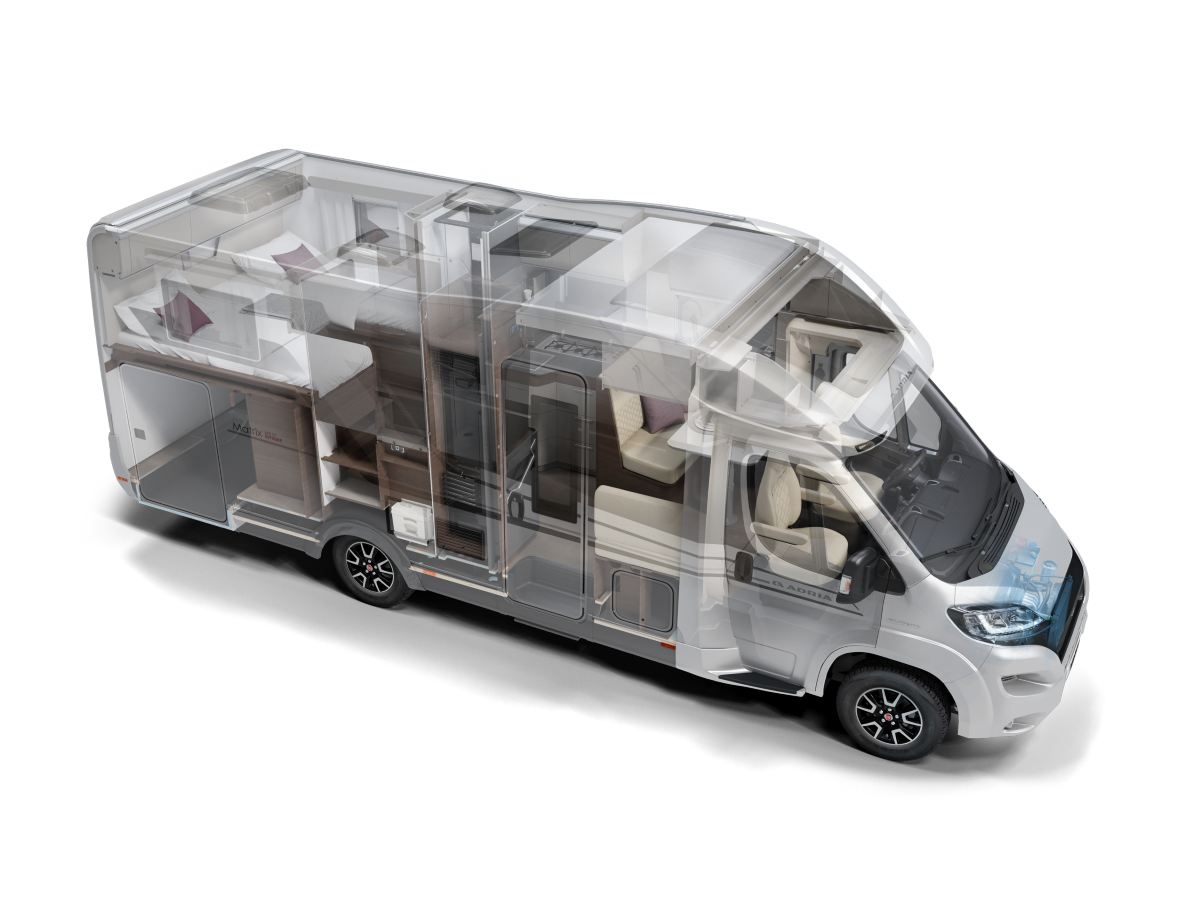
3D printing is often associated with lightweight solutions. However, the technology also offers opportunities to integrate functions. This is exactly what has caught the attention of Bostjan Zagar, founder and CEO of Centre for Applicable Polymers (CAP). He wants to use printed electronics to create groundbreaking innovation in the caravan industry.
CAP, which will change its name to Polymers Group in late 2025, has been supplying thermoset composite components to the marine industry for about 15 years. Lightweight composite components such as steering wheels and steering tillers, interior headliners and gangways. About five years ago CAP added thermoplastics composites to its material portfolio. In doing so, it serves a second market, the European caravan industry. “Meanwhile, more than half of our sales come from thermoplastic composites,” says Bostjan Zagar, founder and CEO of the lightweight specialist in Medvode, Slovenia.
With a complete set of interior panels, CAP saves up to about 100 kilograms of weight per caravan


Lighter alternative to wood
The European caravan industry processes a lot of plywood, often sourced from Asia. “Our material is lighter and completely of European origin. Ecologically therefore more attractive by eliminating transport from Asia,” Bostjan Zagar explains. CAP replaces the wood layer (on the inside of the caravan however new products for exterior usage are in development) in these sandwich panels with a thermoplastic layer in both interior headliners, structural parts for caravans as well as roof structures made of fiber-reinforced composites. The lightweight interior panels weigh only 25% of traditionally used panels and absorb sound three to five times better than plywood or GRP does. With a complete set of interior panels, CAP saves up to about 100 kilograms of weight per caravan. For most customers, CAP is a development partner. Bostjan Zagar: “They design the caravan, but involve us early on in the project because of our knowledge of the limitations of our technology. We co-design the parts, build the prototypes and then produce the endparts, usually up to 2 to 3,000 units.”
Low cost tooling
Until a few years ago, the use of thermoplastics for the caravan industry was not economically feasible. The series are usually larger than in the marine industry, which places higher demands on tooling. “The caravan industry cannot afford high tooling costs, whereas you have them with the larger series in this sector,” Bostjan Zager explains. CAP manages to avoid the high costs by making wooden molds as well as milling aluminum molds for series production of the parts. Low cost tooling, the founder of the composites company calls this. “This allows us to transfer lightweight materials from the automotive and marine industries to the caravan industry.”
3D printing molds?
Centre for Applicable Polymers is one of 32 partners in the European 3DOP project, aimed at industrializing 3D printing in SMEs. Among other things, it participates in the group working on 3D printing molds. Is this an alternative technology to the production of wooden molds? Bostjan Zagar doubts it. The molds CAP needs are large. “For that, we need to use robot extruders in robotic milling machines. The dimensions are too large for most printers.” The Slovenian SME does, however, work with a partner in Italy to produce tooling. This is still in a testing phase. “Mechanically, 3D printing can replace the production of a wooden mold. Economically, however, I am skeptical,” the entrepreneur acknowledges. It would only make financial sense if one could print the large molds currently made of aluminum from plastic for at most the same cost. “We are not that far yet. Extrusion robots with milling capability are still in a lab phase. The systems are not yet at an industrial level.”
Using LEDs to integrate info panels into caravan interiors
Printed electronics in the caravan
Bostjan Zagar is therefore much more interested in another work package of the 3 DOP project, namely in which companies work with knowledge institutions to research 3D printing of electronics. “That is very relevant to us,” he says. With it, he wants to create a completely new solution for interior panels in caravans. Bostjan Zagar wants to co-print LEDs so that the interior lighting is integrated into the panel and included in the production at CAP all at once. This not only provides a unique design, but saves caravan builders assembly costs. One step further is using these LEDs to integrate info panels into caravan interiors. On these, different information can be displayed. “Replacing tooling with a 3D printed mold doesn’t interest caravan builders. But such new technology for integrated lighting and info panels does. Manufacturers want as many automotive features in their caravans as possible.”
3DOP is totally different, less bureaucratic and more focussed on our needs and our questions as a SME
Foils deform
Bostjan Zagar has long been running around with the idea of using printed electronics to develop innovative panels for caravans. “But we didn’t have the right partners. And for such an innovative project you have to work with the right partners. We are a small company, with 9 employees. We can’t afford to be busy with basic research.” The difficulty, in fact, is forming the foils with which to work; the foils must be modified for this purpose. That knowledge is provided by the project partners CAP has found in the 3DOP project. “We are getting the basic knowledge for the first entrance to the market,” he said. By the way, 3DOP is not the first European innovation project the Slovenian company is participating in. It is, however, an innovation project that is different from the others, Bostjan Zager believes. “3DOP is totally different, less bureaucratic and more focussed on our needs and our questions as aSME. Our partners in the project give us the answers we need to develop the application.”
Knowledge dissemination through a demo product
He likes the lower bureaucracy so far. That suits an SME much better. And a final difference with other EU projects is that the dissemination of knowledge is not done through papers but through actual applications. In 2025, CAP wants to present the panel for the caravan industry with integrated lighting and info panel at a major caravan fair, to surprise its customers. “That is our demo product that we will have ready by then. I know that for sure.”