For many applications, classic 3D metal printing (with Laser Powderbed Fusion technology) is often too expensive. In the 3DOP project, Opiliones 3D has developed a cheaper alternative based on its own Delta filament printer and granulates. This not only requires a much smaller investment; the granulate costs only a fraction of metal powder. One bottleneck remains: the required investment in sintering equipment. However, this is not insurmountable for 3D printing service companies and metal injection molding companies.
The workshop and office of the Dutch 3D printer manufacturer Opiliones 3D are now housed in the Royal Eijkelkamp factory in Giesbeek. Not by chance. After six years of development, the Gelderland-based family business is the launching customer for Opiliones’ metal printing technology. Not yet for the serial work, but to produce working metal prototypes of the special drilling heads.
If you can 3D print metal parts in 24 or 48 hours, you won’t need any more warehouses
Why Delta printer?
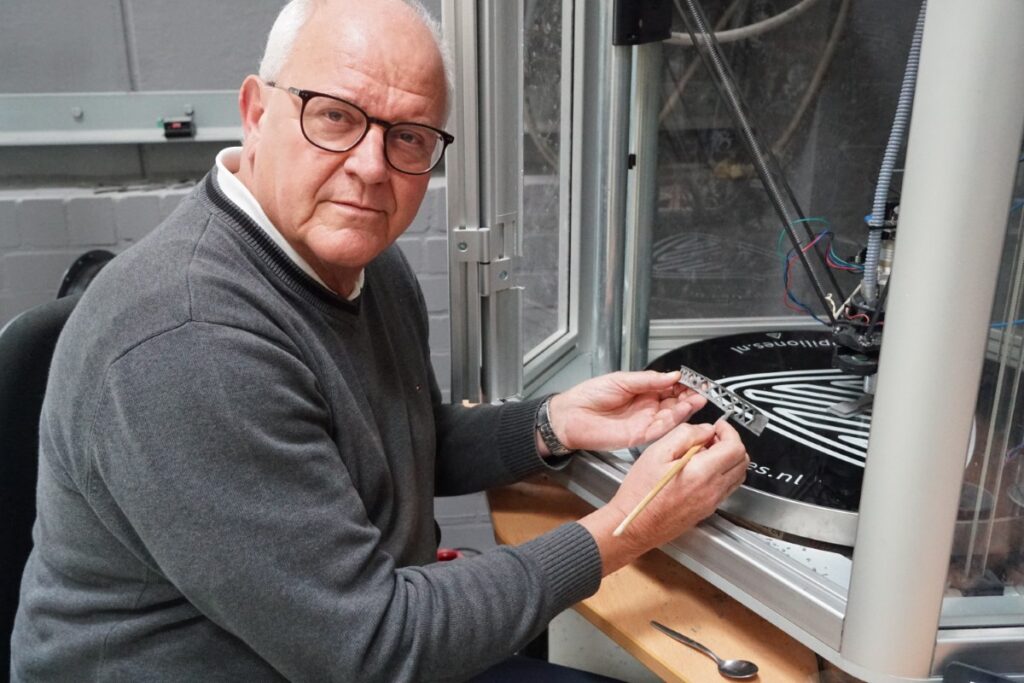
“For series work or fine geometries, you have to go to the powderbed machines. With our machine, we can print all geometries that a standard FDM printer can print. No more and no less,” says Peter Sluiter, co-founder and director of Opiliones. Together with Kees Koese and his son Lucas, inventors, he founded Opiliones in 2014. They chose the so-called Delta FDM printer, because you can easily scale up that concept to larger formats and in terms of robustness it is better suited for a workshop than a desktop 3D printer. The Opiliones Delta concept also offers versatility in terms of the use of raw materials: polymers but also composites, concrete and now metal. The reality ten years ago was that Opiliones 3D built the cheapest 3D printer per cm3 of built-up material at the launch. Within two years, Chinese competitors overtook the Dutch manufacturer. Admittedly with a slightly smaller size, but Peter Sluiter saw that you can’t compete at those prices. “We needed a few more years to clear the machine of teething problems. We were not given that time.” Because a lot of knowledge had been built up about FDM technology, Opiliones turned it into a revenue model. The company has further developed the technology for concrete printing, among other things. No complete houses, but parametrically designed wall elements with, for example, integrated irrigation or elements for interior walls with integrated features for technical installation. 3D printed directly from the computer drawing in manageable stone elements weighing up to 23 kg.
We are going for the large market for which the laser powder bed technology is too expensive
Metal printing in the workshop
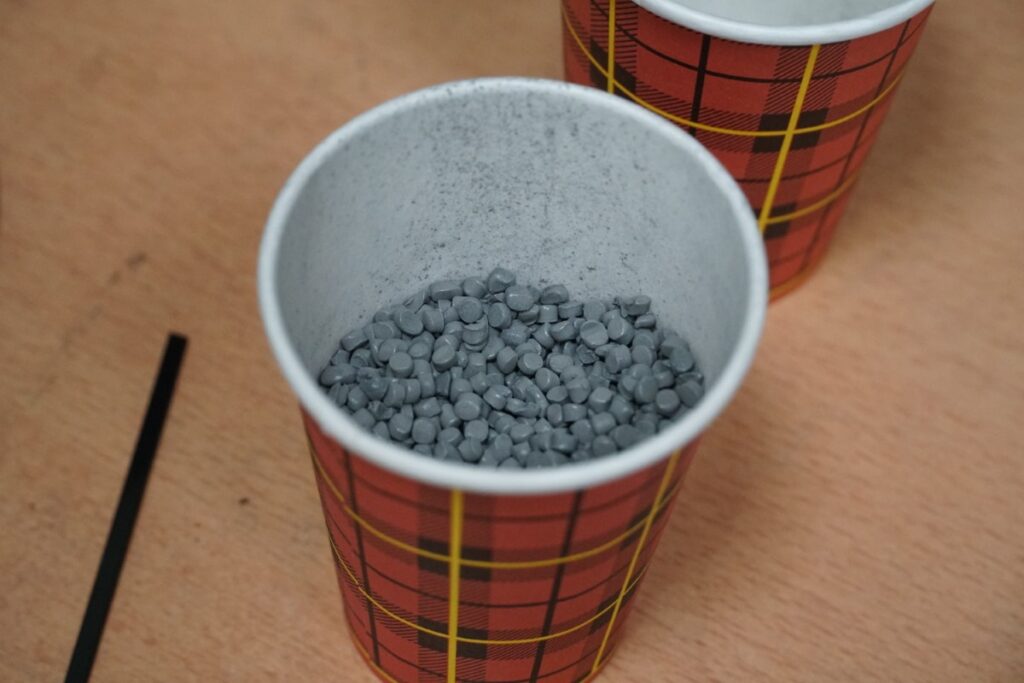
In 2018, Peter Sluiter and Kees Koese took the step to metal printing, but at low cost with a system that is suitable for a workshop environment. “A metal printer that you can operate after only one afternoon of instruction,” he adds to the list of features. Printing is done with MIM granulate (Metal Injection Molding), pellets that contain 80% metal powder that is held together by a plastic binder. This material is widely available in numerous alloys. “We are going for the large market for which the laser powder bed technology is too expensive,” says Peter Sluiter when outlining the target group. Machine and equipment builders, who sometimes need prototypes or single pieces and small series, e.g. spare parts. Peter Sluiter: “If you can 3D print parts in 24 or 48 hours, you don’t need warehouses anymore.”
Speciale extruder
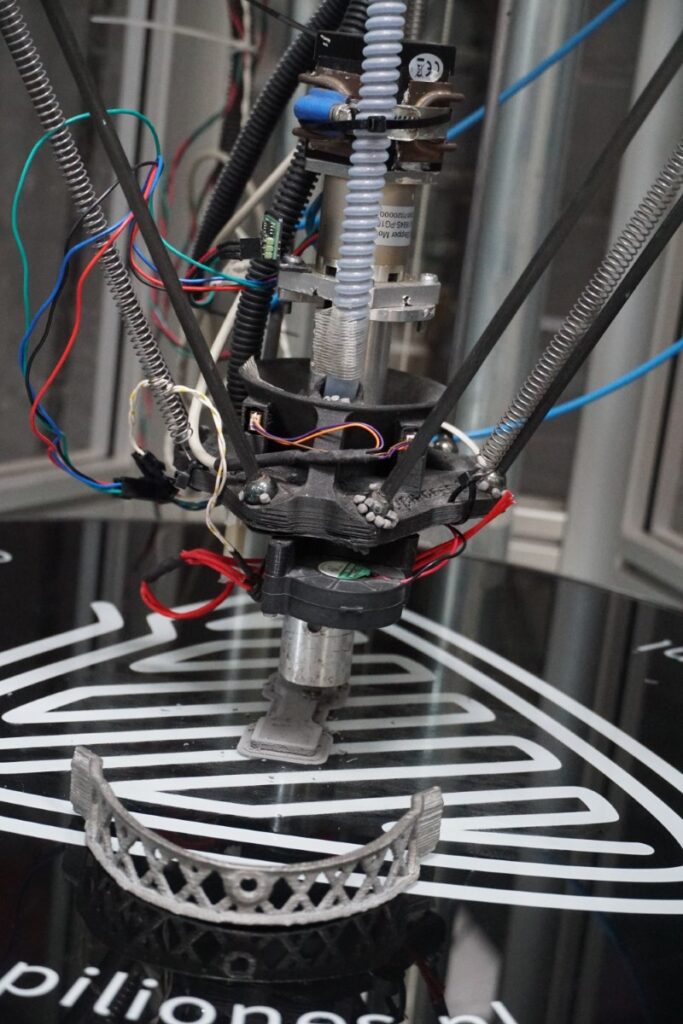
The first step the printer manufacturer has taken, is the development of a special extruder. What happens in an extruder of 1.5 meters in length in a MIM system must be done in 15 centimeters in the Opiliones 3D printer. The temperature rises over this distance from 45 degrees C to 240 degrees C. With three sensors and fans, this objective has been achieved. The right temperature window was also a challenge: after all, the temperature is a determining factor for the adhesion of the layers. A relatively simple but smart system ensures a continuous supply of the pellets. A special feature of Opiliones’ concept is that it has developed a simple solution to prevent overhanging parts of the workpiece from deforming during sintering, because the support structure has been removed during washing. Except for the fine adjustment and industrialization of, for example, the temperature control, this cost-effective metal printer is now ready.
Sintering furnace
The bottleneck of this technology is the need for an expensive sintering furnace. The green part that the Delta printer prints, first goes into a washing bath and then into an oven to burn out the last remnants of polymer. This is followed by the sintering process in which the material gets its density up to 99.8%. Peter Sluiter: “For that process, you need really expensive sintering furnaces. We have tested cheaper ovens, but at a lower temperature you get a lower density.” He does want to investigate the possibility of sintering at a slightly lower temperature for a longer time. Suppose you then end up with 90% density, then you could, for example, print 10% thicker walls to achieve the right strength. If this makes sintering cheaper, one will expand its target group.
For which target groups?
Because a sintering furnace requires a high investment, Peter Sluiter does not think that we will soon see such an Opiliones 3D metal printer in every metal shop. He sees two groups of companies for which low-cost metal printing technology is interesting: MIM companies and 3D printing service agencies. Opiliones has already made agreements with Demcon 3D and Oceanz about a follow-up of the 3DOP project. The first company is a supplier of MIM components and therefore already owns professional sintering furnaces. The second company is a 3D printing service agency. For such companies, the investment in the furnace pays off because they can scale up 3D metal printing by offering low cost 3D metal printing as a service. In early 2027, the two companies will be launching customers together with Royal Eijkelkamp.
Thanks to the 3DOP project, we have moved forward faster
Innovate faster thanks to 3DOP
What role has the 3DOP project played in the development of cost-effective metal printing? Peter Sluiter, who became involved in the European innovation project through OostNL, says: “Thanks to this project, we have moved forward faster. Otherwise, we wouldn’t have had the resources to develop the technology so far.” In addition, he appreciates the contacts he keeps from the project. Without such a European project, it is almost impossible to build such a network. For example, through the open call of the 3DOP project, there is contact with an Italian car restorer. Together, they will investigate whether the metal printing technology is suitable for producing parts. For a second Italian company, Opiliones is investigating the repair of aluminium extrusion moulds with the Delta metal printer. In addition, he rolled into an ecoprint project through Sirris, as a spin-off project of the 3DOP project. “The contact with the foreign partners is fruitful. And what is unique about the project is that it was conceived and thought of for small and medium-sized enterprises. That makes it interesting for a larger group of companies.” With this last remark, he means that SMEs use a different way of innovating than large companies. SMEs innovate much more through trial and error. “If it works, you can quickly make short hits and you can do really disruptive things, where innovation at the larger companies is often much more a kind of product development.”
Funding for SMEs
However, he also wants to make some critical comments. A company with four employees communicates differently than large organizations and has different priorities. Keep it simple, to the point. “Collaboration with small companies is different from collaboration with large ones,” says Sluiter. Time is scarce in an organization where innovation is part of the daily tasks and not a task for a separate department. Moreover, the funding of such a project has more impact on an SME than on a large company. “The last 30% of the 3DOP project is only paid six months after the end of the total project. In such a large project, the work of the participating companies is sometimes already halfway through. Then you have incurred all the costs. You will have to wait another two years for your money. That is tough for SMEs.”
Economic spin-off is coming
His arguments do not alter the fact that he is happy with the European innovation projects. Peter Sluiter is convinced that these projects will eventually result in economic activities, such as the production of 3D printers for cost-effective metal printing. He already has a Dutch partner for the production. Isn’t he afraid that Chinese competition will soon overtake Opiliones again? “No”, says Peter Sluiter. “The smaller the niche, the less likely people are to go to a Chinese competitor. We can develop everything that is niche very well in the Netherlands. If this catches on, we will align our metal printing with companies that have the infrastructure.”
And what will Opiliones do then? Peter Sluiter: “Continue to innovate. Probably again with 3D printing, because that’s where our heart and knowledge lies.”